 -20% on many items!
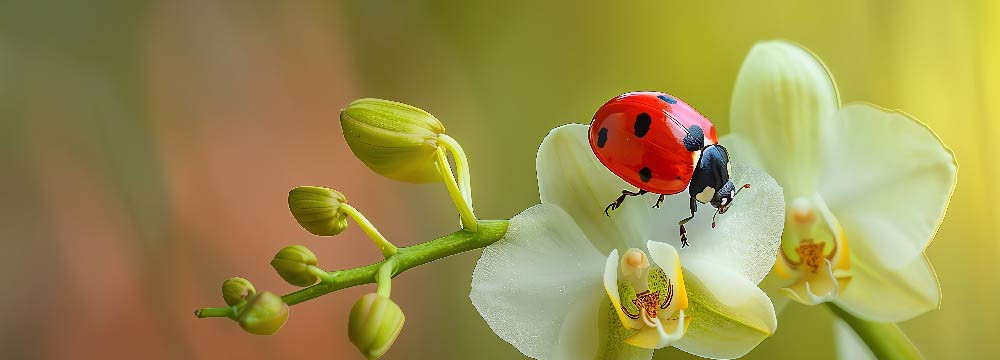
Ladybugs

Everything you need to know about the ladybug, the fascinating seven-spotted insect
What are the main characteristics of ladybugs?
How to recognize a ladybug?
Ladybugs are small, fascinating, and easily recognizable insects.
The best-known species are the seven-spotted ladybug and the two-spotted ladybug. However, there are many species of ladybugs with different colors and patterns. For example, you can find a yellow ladybug, a red ladybug, or even a 22-spotted ladybug.
The number of spots on the elytra can vary considerably, ranging from two to more than twenty. Ladybugs can be observed in various environments, especially on fruit trees and plant leaves. They are particularly useful because they feed on aphids and other small harmful insects.
Adult ladybugs are often seen near an aphid colony, where they find the best conditions to feed and lay their eggs. Some ladybug species, like the 10-spotted ladybug, are less common but just as important for the ecosystem. Aphid-eating ladybugs are particularly beneficial because they mainly feed on aphids and scale insects.
It is important to protect all ladybug species and return them to nature if found indoors, as they play a crucial role in the natural control of pest insect populations.
What are the different species of ladybugs?
Most ladybugs are recognizable by their black spots on a red or orange background. Some ladybug species, such as the two-spotted ladybug and the bryony ladybug, are distinguished from each other by their unique patterns. Ladybugs can be valuable allies in the fight against harmful insects, as they mainly feed on aphids and scale insects.
This ladybug is a natural helper for controlling aphids in gardens. Females lay their eggs near aphid colonies so that the first larvae have access to their food source.
Some people even create a ladybug shelter to attract these beneficial insects. In winter, some ladybugs gather in groups inside houses to hibernate.
There are many species of ladybugs in the world, each with its own ecological role.
What is the difference between a 7-spotted ladybug and other species?
Ladybugs are part of the Coleoptera order, a very diverse group of insects. The red 7-spotted ladybug is one of the best-known species, but there are many other ladybug species in the world.
The characteristics of the 7-spotted ladybug include its bright red color and its seven distinctive black spots.
Where are ladybugs found?
Ladybugs are often found in gardens, like the 7-spotted ladybug which can be seen on plants. For example, you might see ladybugs on your rose bush covered in aphids. In fact, ladybugs are more effective than ants at controlling aphids and scale insects.
Most ladybug species are carnivorous. The ladybug larva, just like the adult, feeds mainly on other insects like aphids. However, if ladybugs lack food, they will eat each other.
Interestingly, it is the 2-spotted ladybug that is the most voracious, while the female 7-spotted ladybug can lay up to 1000 eggs in her lifetime.
What is the life cycle of ladybugs?
How does the metamorphosis of the ladybug larva occur?
The metamorphosis of the ladybug larva is a fascinating process. Beetles like the ladybug go through several stages of development.

Where are the eggs found?
Generally on plants infested with aphids and scale insects, which are their main food. Ants protect aphid colonies, which can make the task difficult for ladybugs.
Once hatched, ladybugs and their larvae feed voraciously. The larva molts several times before turning into a pupa.
It is at this stage that the metamorphosis takes place!
The inside of the ladybug completely reorganizes. After a few days, the adult emerges. The fact that the ladybug is capable of metamorphosis makes it a fascinating insect to study. There are over 6,000 species of ladybugs in the world, each with its own characteristics. For example, the Asian ladybug is also known for its invasion in some regions.
What is the lifespan of an adult ladybug?
The lifespan of an adult ladybug varies depending on the species and environmental conditions.
In general, it can live between 3 months and 1 year.
Ladybugs born in the spring or summer tend to have a shorter lifespan, about 3 to 4 months. Those that hatch in late summer or autumn can survive the entire winter in a dormant state and live up to a year. Factors that influence their longevity include food availability, climatic conditions, and the presence of predators.
In captivity, with proper care, some ladybugs can live up to 2 years. However, in nature, most adult ladybugs only live for a few months before laying their eggs and dying.
How do ladybugs reproduce?
Ladybugs reproduce sexually.
In the spring, males and females mate after a courtship ritual. The female then lays yellow, rod-shaped eggs, usually on the underside of plant leaves.
After a few days, the larvae hatch. They resemble small alligators and go through four stages of development, feeding mainly on aphids. After two to three weeks, the larvae transform into pupae. The final metamorphosis takes place about a week later, giving rise to adult ladybugs.
The young adults are initially pale and soft, but their shell hardens and colors quickly. A female can lay up to 1,000 eggs during her lifetime, thus ensuring the survival of the species.

What do ladybugs eat?
Why are ladybugs considered useful insects?
Ladybugs are considered very useful insects for several reasons:
- First, they are excellent natural predators of aphids and other small insects harmful to crops.
A single ladybug can devour up to 5,000 aphids in its lifetime, making it a valuable ally for gardeners and farmers in controlling these pests ecologically.
- Furthermore, ladybugs play an important role in plant pollination.
As they move from flower to flower in search of prey, they unintentionally carry pollen and thus participate in the reproduction of plants.
- Finally, their presence in an ecosystem is a good indicator of biodiversity and environmental health, as they are sensitive to pollution and pesticides.
Do ladybugs eat anything other than aphids?
Ladybugs are best known for feeding on aphids, but their diet is actually more varied.
These small beetles also consume other harmful insects like scale insects, mites, and whiteflies.
This diversity makes them excellent allies for biological control in gardens and crops.
In addition to insects, some species of ladybugs feed on pollen and nectar from flowers. This allows them to supplement their diet, especially when prey is scarce.
A few ladybugs are even mycophagous, meaning they consume microscopic fungi.
There are also species of phytophagous ladybugs that feed on plants. For example, the Mexican bean beetle can cause damage to legume crops.
However, the vast majority of ladybugs remain beneficial predators for agriculture and gardening.
How do ladybugs find their food?
Ladybugs are effective predators that use various methods to find their food.
They primarily rely on their sight and smell to locate their prey. These insects have compound eyes that allow them to detect movement and shapes at short distances. They are particularly attracted to the bright colors of aphids, their main food source.
In addition, their antennae are equipped with sensitive olfactory receptors that detect odors emitted by their prey and infested plants. Once near their food, ladybugs use their legs to explore their environment and their mouthparts to taste surfaces.
They are capable of traveling long distances in search of aphid colonies, guided by their instinct and experience. This combination of senses allows them to efficiently find their food in various habitats.

How to attract ladybugs to the garden?
What plants attract ladybugs?
Ladybugs are beneficial insects for the garden, feeding mainly on aphids and other pests.
To attract them, it is wise to plant certain plant species.
Aromatic plants like mint, fennel, and dill are particularly appreciated by ladybugs. Wildflowers such as tansy, yarrow, and daisy are also effective in attracting them.
Some vegetables like carrots, potatoes, and squash can also serve as a habitat for ladybugs. By diversifying your garden with these plants, you will create an environment conducive to the settlement of these precious helpers, thus contributing to a balanced ecosystem and natural biological pest control.
How to create a favorable environment for ladybugs?
To attract ladybugs to your garden, start by creating a natural and diverse environment.
- Plant a variety of nectar-producing flowers like yarrows, cosmos, or sunflowers.These plants will attract adult ladybugs who feed on nectar and pollen.
- Avoid the use of chemical pesticides that can harm ladybugs and their prey. Opt instead for biological pest control methods.
- Leave some areas of your garden a little wild, with piles of dead leaves or wood, which will serve as shelters for ladybugs. Install shallow water sources so ladybugs can drink.
- You can also build or buy insect hotels specifically designed for ladybugs.
By creating this favorable environment, you will encourage these valuable helpers to settle permanently in your garden.

Are ladybugs dangerous to humans or animals?
Can ladybugs sting or bite?
Ladybugs are generally considered harmless and beneficial insects for gardens.
However, it is important to note that they can indeed bite, although it is rare and generally harmless to humans. Their mandibles, although small, are capable of lightly pinching human skin if they feel threatened.
This bite is usually described as a slight tingling sensation and does not cause significant damage. It should be noted that ladybugs do not have a stinger and therefore cannot sting like bees or wasps would.
Some species can secrete a foul-smelling liquid as a defense mechanism, but this is not harmful to humans.
In general, ladybugs prefer to flee rather than attack when they feel threatened.
What to do if you find a ladybug in your house?
If you find a ladybug in your house, don't panic!
These small insects are generally harmless and even beneficial for the environment.
The first thing to do is not to harm them. You can simply capture it gently with a glass and a piece of paper, then release it outside.
If you find several ladybugs, it may be that they are looking for shelter to hibernate. In this case, you can leave them alone in a little-used corner of the house.
To prevent other ladybugs from entering, be sure to seal cracks and openings around windows and doors. You can also use natural repellents like lavender or lemon to deter them.
Remember that ladybugs are valuable allies in fighting aphids in your garden!

What is the difference between native ladybugs and the Asian ladybug?
Why is the Asian ladybug considered invasive?
The Asian lady beetle (Harmonia axyridis) is considered an invasive species for several reasons:
- First, it reproduces very quickly and in large numbers, outcompeting local species. In addition, it has few natural predators outside its native habitat, allowing it to proliferate without control. It competes directly with native ladybugs for food and habitat.
- Second, this ladybug can cause damage to crops by attacking ripe fruits. It also poses problems in homes by seeking shelter for the winter.
- Finally, it can cause allergic reactions in some people. For all these reasons, the Asian ladybug is seen as a threat to local biodiversity and the balance of ecosystems.
How to distinguish an Asian ladybug from a European ladybug?
To differentiate an Asian ladybug from a European one:
- First, observe their size : Asian ones are generally larger, measuring about 7-8 mm, while European ones are about 5-6 mm. 2.
- Next, examine their patterns. Asian ladybugs often have more numerous and irregular spots, sometimes fused. Their color varies from orange to bright red, with black markings. European ones generally have simpler and more symmetrical patterns, with fewer spots. 3.
- Finally, look at their head. Asian ladybugs often have a white mark in the shape of an "M" or "W" on the pronotum (the part between the head and the elytra). This mark is absent in European species.
- In addition, Asian ladybugs can emit an unpleasant odor when disturbed, unlike European ones.

How to use ladybugs as a biological control against aphids?
What are the advantages of using ladybugs instead of pesticides?
Ladybugs offer many advantages over chemical pesticides for controlling pests in gardens and crops:
- First, they are a natural and ecological solution. Unlike pesticides, ladybugs leave no toxic residue and do not pollute the environment. They fit perfectly into the balance of the ecosystem.
- Second, ladybugs are very effective at eliminating certain pests like aphids. A single ladybug can devour up to 100 aphids per day. Moreover, they reproduce naturally, ensuring long-term protection for crops.
- Finally, using ladybugs helps avoid problems related to pesticides such as pest resistance or dangers to human health.
It is therefore an interesting and beneficial long-term alternative for agriculture.
How to introduce ladybugs into your garden or crops?
To attract ladybugs to your garden, start by creating a favorable environment.
- 1. Plant nectar-rich flowers like tansy, fennel, or marigold. Avoid using chemical pesticides that could repel or kill them.
- 2. You can also buy ladybug larvae from specialized suppliers. Release them in the evening or early morning, near plants infested with aphids. Ensure the garden is sufficiently moist and offers shelters like piles of dead leaves or small bundles of wood.
- 3. To maintain a stable population, leave some wild areas in your garden and install insect hotels. Remember that ladybugs need prey to survive, so tolerate a small presence of aphids to feed them.